Thursday, April 19, 2012

More Ring to Boston


                                         Daoine ón Rinn  -  Boston 1983/87  -  Cuid 2


    Maurice Curran


John Joe Burke


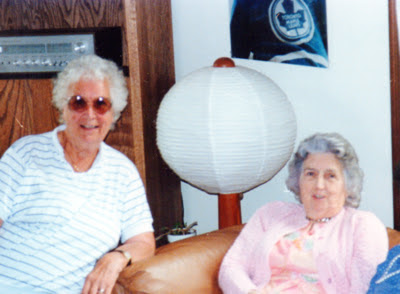
  Mamie Curran   ;   Nonie (Burke) Gaffney


  John Walsh (U.S.-born member of the extended Cûl Rua / Abbeyside family) & John Joe Burke


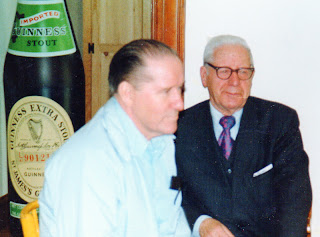
Bernie Gaffney (husband of Nonie Burke).  John Joe Burke & Mâiread (Whelan) Smyth


  Maurice Curran ;  John Walsh ; Paud Curran ; John Joe Burke & Bernie Gaffney


  Maggie Walsh ; &  Anne (Shanahan) Keane

 
 Annie (Walsh) Johnson  -  visiting Boston from Chicago;  &Nora ; (Walsh) Guinane

Tuesday, April 10, 2012

Ring to Boston


                                         Daoine ón Rinn  -  Boston 1983/87  -  Cuid 1


      Mary (Fitzgerald) Curran   ;   Margaret (Fitzgerald) Murray   ;   Jimmy Walsh  ;  Pádraig Ó Cuirrīn (back).


    Jimmy Walsh   ;   Kit (Power) Barry


  Kate Drummey   ;   Margaret (Kenneally) Drummey   ;   John Drummey   ;   unknown   ; Johnny Morrissey (whose parents came from Baile na nGall)


   Mick Drummey   ;   John Drummey


     Mick Drummey in a pensive mood!


Nicholas Kenneally (brother-in-law of John Drummey)

Saturday, March 31, 2012

Bidding the Green Island goodbye

By Patrick Henry Curran
An Rinn
It is all too common nowadays in An Rinn and elsewhere to witness farewell parties in local pubs for young people (mainly young men) heading off to far-flung places. Australia seems to be the destination of choice, although not exclusively so. In any event, all of these partings set me thinking back to a time in my own (now distant) past, when I emigrated to Canada.

Early traditional Ring Cottage


Let me say upfront that I left Ireland more out of choice rather than necessity. Having done the Leaving Certificate in Meánscoil San Nioclás in 1962 and having spent a year at Pallaskenry Agricultural College, Limerick I got a job as a “field technician” with An Foras Talûntais (the forerunner of Teagasc) towards the end of 1963. I thought I had it made at 7 pounds and 10 shillings a week (at the time of joining the standard work week was five and a half days but that was soon cut to five days). The job initially involved desk work in an office in Sandymount Avenue in Dublin but after a time some of us were given cars (by then I had acquired a driving license) and we were assigned to collecting data from farmers in various parts of the country. This work was all part of a first attempt at a comprehensive analysis of the state of farming in Ireland.
View of Murray's Pub in Ring

The work and the travel was all very exciting at first but by about 1967 I was getting restless and I felt that I needed to see a bit of the world. As it happened a boarding guest appeared in my parents home in An Rinn, who introduced himself as an academic from a university in far off Canada with an interest in Celtic studies. We got talking and I showed him around the countryside a bit. The result was that he promised to assist me with gaining entry to his college in Canada if I managed to sort out the formalities of legally emigrating to that country. This two-pronged plan was set in motion ; I contacted the Canadian Embassy in Dublin and he presented my Leaving Cert results to the University of Windsor in southern Ontario. 

University of Windsor Campus
In due course, success emerged on both fronts – I was cleared for emigration to Canada and university entry was available to me. Then, of course, the real soul-searching commenced. Was this what I really wanted? Did I want to turn my back on family, friends and footballing team-mates? Could I even afford to support myself through college? If I went would I ever return? These and many other questions ran through my mind, even as the clock started to tick towards setting a departure date.


By about April 1968 (and having turned 23 years) I had settled on mid-June for leaving – and the reality of this decision began to hit home. Like most Irish families at the time emigration was practically in our DNA. My father had spent from 1923 to 1932 in Boston. 


My mother had seen five of her siblings depart for the United States and she never met three of them again. The biggest worry was my father who was by then elderly and in poor health. I will always remember sitting with him – just the two of us in the house - to watch the European Cup match between Manchester United and Benfica on 29 May 1968. I knew and he knew that once I had gone in a few weeks we would not see each other again.

Last view of Cobh
To compound matters the United States (and in some minds, by extension, Canada) was constantly in the news for the wrong reasons. The Vietnam War was raging; President Lyndon Johnson announced that he would not run again; Martin Luther King was murdered on 4 April, precipitating riots in over a hundred cities (including Detroit, just across the river from Windsor); Robert Kennedy was assassinated in Los Angeles on 5 June. To my mother these were all good reasons for me not to venture next nor near North America!

Dublin Airport c1960s
However, I stuck to the plan and 18 June found me at Dublin Airport, battered suitcase in tow, new passport in hand and ready to board a plane for the first time and leave Ireland's shores, also for the first time. There was no hiding that I was nervous and apprehensive about the whole venture. I had arranged with a fellow called Eddie Power, whom I knew from An Foras Talûntais and who had earlier emigrated to Montreal, to meet me on arrival at Montreal International Airport.
 I still have that old passport, with a Canadian Immigration Identification Card dated “18 June 1968” stapled to it. Thankfully, Eddie was at the airport and he took me to his home in the Montreal suburb of Lachine. The plan was that I would spend a few days with him and then take the long bus journey south to Windsor, via Toronto. 

Dominion Bridge steel constructors
Eddie introduced me to some people in the company that he worked for – Dominion Bridge steel constructors – and I could have had a job there and then, which would have relieved me of the fears that the 300 pounds in my pocket would not take me very far in this country...However, I decided to follow things through and after three or four days I was on a bus heading for Windsor. I cannot now remember too much about that long journey except that I arrived in Windsor bus station late at night. The man who had arranged everything for me at the university was there to meet me and it was only then that he dropped the bombshell – that he was in fact a Catholic priest, attached to the Order of St. Basil. The background to this is that the University of Windsor, which was by then under the authority of the Government of Ontario, had evolved from a college run by the Basilians and some members of the Order, continued as lecturers at the University during these early years of the transition. Fr.O'Donoghue preferred not to be fussed over as a priest during his visit to Ireland. 
 I spent a couple of nights in the Basilian residence and then I moved into a flat with a lad called Bob Nemeth, who had just graduated from the University. Bob was half-Hungarian, half-Welsh and he is someone that I am still in contact with.

Detroit River
 The accommodation was, to say the least, basic (as befitting students) and what I will never forget is how hot it was during the summer months and how much dust came through the windows – blowing across the Detroit River from the massive automobile manufacturing plants in that neighboring U.S. city. Bob worked for a security company, run by a number of retired policemen. The pay was the minimum wage at the time - $1.25 per hour – but there was the scope to work long hours. The city of Windsor was and still is what in Canada would be referred to as a “blue collar” town, with its own car assembly plants and other industries such as the Hiram Walker distillery. The security work I started doing might involve spending long hours guarding newly assembled cars awaiting shipment or keeping watch in a factory at night or over the weekend. However, while the hours were flexible the pay for this work was poor overall and I became conscious that I needed something else during that first summer in order to be able to advance the tranche of fees due when I started university in September.
 In that respect, and through my Irish innocence, I got lucky. Bob was away for a few days and I dropped into the local pub or “tavern”. I got talking to a German-born electrician who had come to Windsor from Toronto to do some work on a restaurant that was being built. He had not yet arranged accommodation and I suggested that he could sleep on the couch in my flat until he got sorted out. In retrospect, this was a rather crazy thing to do but it paid off because the next day he managed to get me a job as a general labourer on the restaurant building project – at $3.50 an hour!
Early view of Dominion House.

The foreman on the job was called Tony and he was one of the many colourful characters that I was to meet during my time in Canada. As a nationalist from one of the Baltic States he had fought on the side of the Germans in the Second World War and he took great delight in telling stories of battles against what he saw as the Russian oppressors. A couple of Italians on the job got dog's abuse from Tony because of Italy's perceived poor performance in the war. I got along well with him and he would give me some extra work at the weekends. The only time I sailed close to the wind was when the Warsaw Pact forces invaded Czechoslovakia on 24 August to bring the “Prague Spring” to an end. Suggesting to Tony that the reformist Dubcek government may have provoked this Russian-inspired intervention by moving too far too quickly was not the smartest move on my part!

Anyway, we parted on good terms in early September. I was able to pay the university fees with the money I had earned and saved in the course of the summer. I was free to continue the security work while studying, which kept me ticking over during the school year.

Even after a brief period it became clear to me that Canadian practices were somewhat different to what I had left behind. The law pertaining to taverns at that time reflected a somewhat puritan attitude, especially in the Province of Ontario, to drink (and perhaps interaction between the sexes). Each tavern had two separate sides – one for men, where only beer was served, and the other for “Ladies and Escorts”, serving mixed drinks and wine in addition to beer. Single men were not allowed to sit on the latter side and, of course, women could not enter the men-only bar.  A curious situation indeed – but then what would Canadians think of our “Holy Hour” or the concept of the “snug”! Eventually, I learned that the two favoured drinking haunts for students were the Dominion House and Sid's Bridge House – and lively places they proved to be.  And it was a lot more interesting to sit on the mixed side...


Pierre Elliot Trudeau from the French-speaking Province of Quebec had become Prime Minister of Canada in April 1968, so I had arrived in the middle of “Trudeaumania”. A decent if somewhat conservative country was now beginning to assert itself in terms of its historical links with Britain and the Empire/Commonwealth, and its relationship with its powerful neighbour to the south. Canada was indeed reaching out to the world at large under this new charismatic leader.
A young Chap from Ring in present day Australia


What adventures awaited me thereafter are for another day ; suffice to say that the challenges that were overcome in the immediate months after my arrival in Canada were indeed formidable. It might be glib to suggest that I was too busy surviving to feel homesick but that would be untrue as it was there in the background throughout. Young people now undertaking that same life-altering venture will undoubtedly feel the same emotions, but at least they have the comfort of cheap and almost instant communication with home – and the world has definitely shrunk since far-off 1968.
 Abbeyside emigrant to Perth. Mark Cahill (left) with wife and Australian born son

Thursday, March 15, 2012

Back left john 'Watt'Walsh' and the late Johnny O'Connor, great Waterford hurler. front, left to right Tom Griffin,Tom Kelly & Batt Drummy.
Mike Terry

At Ring College C. Boulal, Laubrais Ó Cadlagh and unknown.

Maura Kelleher, Margaret Costello and unknown, staff  at Ring College

Back, Left to Right ;Kate Killagrew, Michael Ó Brien & Mary Foley. front, Margaret Costello & nell Ahearne from Grange

All unknown, please feel free to send me names of those you may recognise

No No! nort a Bishop, just Ring College Butler, Michael Brien looking his best for his role in the play.


Wednesday, March 14, 2012

Dungarvan Square Market day
Ring College 1960.Left to Right; Mike Terry,Ring,Seamus O'Cleary,Waterford,Frank Isdell, Old Parish. Muris Buldlear and unknown.
Micheál Ó' Donaill at Mayor Daly monument


Ring play. left to Right; Garda Sullivan, Seán Regan, Unknown & Danny Murphy who was a postman in Ring.
Front Peg Regan,Mikey Brien, Deirdre Haugh

Laying electric cables at Ring College, 28-8-75.Pats Donnell standing and Unknown Moroney driving J.C.B.


Mr. Michael Terry

Mr L. Ó' Cadhla at Ring College


Tomás de Bhial

Uknow Group


I love this picture,Mikey Costin and Bridget Galvin, the youngester is Mossie Galvin, note the old shopping bag that Mikey is carrying, his bike thrown against the wall and the bicycle clips on his pant.

Saturday, February 11, 2012


Youghal Historian Mike Hackett
Sailors and Seamen of Youghal who lost their lives to the water. 
My thanks to Mike Hackett  , Youghal's great historian for compiling this. Some of the sailing vessels which I have attached are un-named at present.


Captain Fleming of Youghal died on the schooner ‘Hertford’ when it
 shipwrecked on the Wexford coast in 1882. It was owned by local merchants
Flemings and the captain was one of the family.

 James Butler of Windmill Hill also died on the schooner ‘Hertford’. James
was actually a baker by trade and this was his first voyage. Patrick
 McCarthy and Seaman Bennett, both of Youghal, were also lost in that
 incident.

 Walter William Burke of Hanover Street contracted Yellow Fever on the
 Tall-Ship ‘Melanope’ in 1894. He died at sea and the vessel brought the body
 into Rio-De-Janeiro, Brazil, where he is buried.

 Miko Loughlin of the Mall died on the schooner William S. Green, shipwrecked
 on the Devon Coast in 1904. Danny Coakley of North Main Street and Tommy
 Walsh of Mary Street also died then on the William S. Green.
The William S.Green


 Jack Smyth of Flemimgs Court, Tallow Street, died on the ‘Annette’ when she
 went onto the rocks below Youghal Lighthouse in 1905. Captain Kirby of
 Dungarvan died on the same occasion.

 Patrick McCarthy of Mouse Street caught a disease on a brigantine, died, and
 was buried in Archangel in Russia. He was grandfather of the late Noel
 Donoghue of Cross Lane.
 Paddy O’Brien of Ballyvergan was lost overboard from the destroyer ‘Cossack’
at Ayr in Scotland, in 1919. He slipped on a steep gangway and hit his head
 on the quay-wall.

Captain Patrick O’Brien of Strand Street, died of blood poisoning on the
‘B.I.’ at Runcorn, Merseyside in 1914, at the age of 32.

Martin Bland of Church Street died on ship in 1920 and was buried in Aruba
 in the Dutch Carribean. He was father of the late George Bland of O’Rahilly
 Street.

James Duggan of Church Lane, in an attempt to rescue a fellow sailor,

 was drowned while the schooner ‘Elizabeth Drew’ was berthed at New Ross in
 1933.

 William Perrott of Wales was drowned in 1933 while attempting to swim ashore
 from the ketch ‘Daisy’ while it was moored in Upper Youghal Harbour. There
 is a memorial to William chiselled into the rock near Youghal Lighthouse and
he is buried in Templemichael graveyard.

 Tommy Smyth of the Alms Houses was lost overboard at Rouen in france in
 1933.

William John Coleman of Quay Lane died aboard ship in 1936 on the way to
 Australia. He was buried at sea.


 Captain Michael Duggan of Church Street was lost on the ‘Nellie Fleming’
 which foundered without trace between the Bristol Channel and Youghal in
 February 1936. Also lost on the same vessel were: Batty Glavin, on the way
 home to his daughter’s wedding; Eddie Sullivan of Raheen Road on his first
 voyage as cabin boy; Dan Kenneally of The Mall, father of a large family;
and Declan Doyle of Penders Lane, eighteen years of age.

 William Ring of 135 North Main Street was lost overboard in Cardiff Docks in
1937. Having managed to hold onto a rope all night, he died the following
 morning from exposure.


John Doyle from Gallagher Terrace fell overboard while on a voyage to
 Australia in 1938. He was a brother to Declan Doyle, lost on the ‘Nellie
Fleming’ two years earlier.

 Connie Troy of Windmill Hill was electrocuted while repairing his fishing
boat at Cobh in 1946.

 Michael O’Regan of South Cross Road was serving in the Irish Naval Service
 on the ‘L.E. Cliona’ in 1952. He took ill on board, was brought to hospital
 but sadly died at just eighteen.

 Patrick Sullivan of South Cross Road, was lost overboard at
 Newcastle-upon-Tyne in 1962.


 Teddy Murphy of Kent Street, was struck down with appendicitis at sea in
 1962 on the ship ‘Ordinance’. He died in Dunkirk hospital.

 Tom Paul Ring of Sarsfield Terrace and Joey Gaule of Mall Lane died while
 asleep in their bunks on the ‘Irish Sycamore’ as it lay docked in New
 Orleans in 1965. Smoke inhalation was the cause of death when a fire started
in an empty cabin next door.

 Gerry Griffin of Brown Street, was lost overboard from the ‘Mossville’ while
 berthed at Cork in 1967. It was said that a plank gangway collapsed.

 Noel O’Brien of De Valera Street died when he fell overboard from a dredger
 on the river Thames in 1968.

Joe Higgins of Strand Street fell between vessel and quay at Greenock in
 Scotland in 1970 and was drowned. The ship was the ‘M.V. St. William’.

 Timothy J. Harnedy from Inchiquin, Killeagh was drowned in 1982 while
swimming at Bondi Beach in Australia. Ted was the ship’s radio officer and
was on leave, awaiting a plane home.
 James Jessie Collins of Raheen Road, died on the tanker ‘Rathcoyle’ in 1994.
Asleep in his bunk, while docked at Ellesmere Port near Chester, he died of
a heart attack.

Fishermen who died in River, Harbour and Bay tragedies.
 James Hannigan of Wesley Place, drowned when a salmon yawl overturned in
Youghal Harbour in 1886. Connie Glavin of Greens Quay was also lost in that
 disaster.

Two Flaherty brothers and two Mulcahy brothers of Monatrea, were drowned
 when their salmon boat capsized at Mangans Cove in 1887.

 Four men were drowned near the Metal Bridge in 1892 when their salmon yawl
 turned over. They were Maurice Keogh, Maurice Fleming, William Keating and
 John White -- all were from Ardsallagh. They were using a dipping-lug sail
 at the time with which it was hard to change tack.
The Kathleen & May


John Hogan of Ardsallagh went for a swim in 1916 at the High Rock near
 Fleming’s Ferry, between fishing the tides., and it cost him his life. He
had his passage booked to America and a tailor named Bride in Youghal was
 making a suit of clothes for him.

 Tommy Smith of Primrose Lane, was drowned in Youghal Harbour in 1923 when
his salmon boat captized. With him and also lost were Pats Murray of
 Monatrea and Tom Aher of Porters Lane. Saved that day was Mike Hannigan, who
 was Cox of the local lifeboat for years.

 Bob Foley of Water treet was drowned when another salmon boat turned over in
 1927. Also lost then were Declan Kenure of Windmill Lane and Jim Boland of
Water Street.

Then in 1933, yet another salmon yawl capsized on the river. Drowned that
 day were Johnny Brennan of The Mall and Tommy Truxie Griffin of Mill Road.
 Rescued were Tommy Muta Heaphy and Mike O’Neill.

 Mick O’Brien-Stokes of Sarsfield Terrace died of a heart attack in his boat
 while fishing down the harbour in 1949.

 Paddy Barry of Ceann a Bhotair (Redbarn) received severe head injuries when
 injuries in hospital.

 Declan Hannon of South Main Street was lost overboard from a fishing boat in
 Waterford Harbour in 1972.

 Danny Twohig of Blackwater Heights suffered a heart attack while hauling his
 nets on the river in 1992. He died in the boat.

 Lost at War

 Richard Ahern of Youghal, died when the ‘H.M.S. Goliah’ was sunk in 1915.

 William Patrick Nolan of Brown Street, died in the sinking of ‘H.M.S.
 Defence’ in 1916.


Michael Mulcahy of Ardmore was killed when the ‘H.M.S. Indefatigable’ was
 sunk in 1916.

 Maurice McGrath of the Clock Gate, died on the ‘H.M.S. Davis’ in 1917.

 John Hyde of the Ferrypoint, died when the ‘H.M.S. Cornwall’ went down in
 1918.

When the ‘H.M.S. Laurentic’ hit a minefield off Malin Head near Derry in
 1917, it cost the lives of four Youghal sailors. They were: Patrick Brennan
 and John Buckley, both of The Mall; William Lynch, Buckley’s Lane; and Jacky
 O’Brien, Windmill Lane.

 William Glavin of Windmill Hill was lost when the minesweeper ‘Mignonette’
 was torpedoed off the Cork coast in 1917.

 Tommy Stack of South Cross Road, Miley Long of Water Street and Jack Murphy
 of South Main Street died in 1940 when the aircraft carrier ‘H.M.S.
 Glorious’ was sunk by battle cruisers in the North Sea.

 Brendan Murphy of Market square and William Kirby of The Mall died on the
 cruiser ‘H.M.S. Gallatea’ when it was torpedoed and sunk off Alexandria in
 1941. It sank in ninety seconds.
 Two more Youghal men died when the battleship ‘H.M.S. Barham’ was torpedoed
and sunk off Alexandria in 1941. They were Jerry Connolly of Cork Hill and
 Bobby Webster of Sarsfield Terrace. The two men were stokers down below and
had little chance of escape following the four torpedo hits.

 Tommy Roche of Water Street died when the armed trawler ‘Lincoln City’ was
 sunk in the North Atlantic in 1941. He is buried on the Faroe Islands.

 Jimmy Walsh of Raheen Road lost his life early during the Second World War
when his ship, a merchantman, was sunk by a torpedo. It is said that in his
 house was a picture of a sailor returning home with his bag over his
 shoulder and his family running to greet him. On the night that Jimmy died
 at sea, the picture fell off the wall for no apparent reason -- the cord had
 not broken and the nail was still firmly stuck in the wall.

 Bill Kelly of Market Square was killed when his vessel, the ‘Swiftpool’ was
 bombed while moored on the Thames river.
Maurice Cooney of Kent Street, on another merchantman, was killed by U boat
 action in 1941.
 Tommy Mulcahy of Market Square died on the ‘Kingston Hill’ after it was
 torpedoed in 1941. He was engaged to be married.

 John Ronayne of South Cross Road was in the merchant navy and was lost as a
 result of U boat action early in the war.

 Edward Fowkes of Ashe Street was on the ‘Shakespeare’ during an aircraft
 attack on the ship. He was killed on deck.

 Peter Lynch of Church Street lost his life when ‘S.S. Milos’ was torpedoed
 and sunk in 1942. His parents later lived in the house which had been the
Fever Hospital at Raheen Road.

 Alfie Hartnett of Barrys Lane was on the ‘Irish Pine’ when it was sunk by
 U-608 in the North Atlantic in 1942. The ‘Irish Pine’ was clearly showing
 neutral markings and was lit up to show the Irish connection. It was a bad
 decision on the part of the U boat captain.

Connie Glavin of Cork Hill died when his vessel the ‘S.S. Miriam

 Thomas’ was run over by an American troop ship in the Irish Sea. There was
 no survivor from Connie’s ship after that calamity.

 Eddie Glavin of Cork Hill, Connie’s brother, died when his ship was
torpedoed, just three days out of New Zealand, in 1943.

 Michael Lynch of Kent Street fell ill on board his ship ‘S.S. British
Renown’ in 1944 and died. He is buried on the Isle of Wight.

 Paddy McGrath of Strand Street died when the ‘S.S. Empire Heritage’ was sunk
by a mine in 1944. He had earlier survived two sinkings by torpedo in the
 North Atlantic
 Captain William O’Brien of The Mall was drowned when he fell overboard at
 Greens Quay from the ‘Rob Roy’ in 1900. It seems that he had been asleep in
his bunk for awhile before he awoke to find the ship ranging (beginning to
 tug) at her ropes due to a build-up of sea swell. A storm was imminent!
 William got up to adjust the fenders of the vessel, ensuring that it would
 not damage itself against the quay wall. Tragically, in the process, he fell
 overboard and was drowned.

 Another Captain, William Jones of Friar Street, was lost from the ‘S.S.’
 Athena’ as the vessel navigated the Majellan Straits in Southern Argentina.
 It happened in 1904, ten years before the opening of the Panama Canal. At
 that time, the only way from the Pacific Ocean to the Atlantic for large
 ships was around Cape Horn, or via the nearby Majellan Straits for smaller
 ones.
 When the ‘Hiland Mar’ went onto the rocks at Ardo Head near Ardmore in 1894,
 it cost the lives of two Youghal sailors. They were named as seamen Bennet
 and Fenton and both were from the Windmill Hill area. The ‘Hiland Mar’ was
 carrying steel for an extension to the Youghal Brickworks on that ill-fated
 voyage. The skipper -- Captain Nagle of The Mall -- escaped by climbing the
 cliffs to reach the nearby house of the Terry family.
 In the second half of the last century, two disasters in Ardmore cost the lives of four of their salmon fishermen. On both occasions, the boats
 overturned. Lost to the sea in 1982 were: Liam Lincoln and Tom Morrissey of
 Ardmore.
Then in 1995 cousins Paul Dunne and Edmond Fitzgerald also died in similar
 circumstances when they were drowned while salmon fishing at Ardmore.

 The total number listed here ( and this may not be complete ) is
 ninety-four.

 God grant peace to all their souls.


Sailors and Fishermen of Ardmore and Youghal remembered

A full-of-colour religious ceremony took place at the Youghal Parish Church when the annual Mass was said last Saturday for all the mariners lost to the water.
Uniforms were in abundance with the Irish Naval Service well represented. Also in attendance were the local Coastguard Service and the Royal National Lifeboat crew. The Mass was said by Canon Tom Browne, assisted by Fr. Denis Herlihy, recently retired back from England.
Another attractive and emotional aspect of the ceremony was the sea-shanty songs and music provided by members of the Lifeboat and Navy. Local historian and author Maurice Ahern, whose forefathers were sailors and fishermen, gave the homily and included a few lovely poems. ‘I must go down to the sea again, to the lonely sea and the sky, and all I ask is a tall-ship and a star to steer her by’.
The congregation mainly comprised members of sea-faring families from Ardmore and Youghal who were deeply moved by the prayers and singing. Everywhere could be seen hankies drying the tears from the eyes of adults as they were reminded of their loved ones -- some of whom have no graves but the deep ocean. Canon Browne spoke of the strong heritage of seafaring in the area and how costly it was during storms and world wars. 

The Offeratory gifts brought to the altar included many medals of honour belonging to forefathers of members of the congregation. Also brought up to the altar was a replica of a tall-ship and a painting of the ‘Kathleen-and-May’ schooner.
At the conclusion of a very inspiring, emotional and prayerful hour, that great lifeboat anthem by Phil Coulter ‘Home from the Sea’ was sung by all.
There was hardly a dry eye in the house.
In this year of the centenary of the loss of the Titanic, it is fitting that like Cobh, the port of Youghal should remember and honour its souls lost to the sea.

The Loughlins of the Mall, Youghal, were a typical seafaring family of the nineteenth century when sailing ships ruled the seas.
Tom Loughlin captained the sailing ship
Perfect, a boat that left Youghal every Spring in the mid-eighteen-hundreds to sail to the Americas. Cargo outwards would be dairy produce and on the return voyage, timber like mahogany was imported. Tom had four sons named Tommy, Michael, Jack and Jim. Tommy was sailing with his father (at just nineteen) when he was washed overboard off the Lizard. Captain Tom had to be forcibly restrained from jumping overboard in what would have been a hopeless attempt to save his son.
Another son of Captain Tom, Miko Loughlin of the Mall, died on the schooner William S. Green, shipwrecked on the Devon Coast in 1904.
Move on to 1917, when Jack Loughlin, then himself a captain, was drowned with all his crew on the
S.S. Ballater (Liverpool). It was during the First-World-War, in September 1917, that a submarine attack caused that loss. Jack was then fifty-two years of age.
And so of the original four Loughlin sons, who sailed out with their father, only Jim (also now a captain) remained. He was affectionately known as Jimo and it was his belief that
Davy Jones Locker had taken enough of the Loughlin family. So Jimo retired from seafaring, settled down ashore and lived to a ripe old age.

Anna Haslam and the Quakers of Piltown and Youghal

My god friend Mike Hackett who resides this side of Youghal Bridge is Youghl's foremost Historian. Mike has several books behind him And...