Pictures and stories of interest about Ring, Dungarvan, County Waterford
Sunday, August 14, 2016
Friday, June 3, 2016
Waterford Society of Friends (Quakers) William Strangman and the Ring Connection.
Joshua William Strangman.
A Quaker of Waterford and his connection with Ring
fishermen.
By Joan Johnson
(From some notes for the unveiling of a plaque
at Ballinagoul Pier, 22nd August 2008).
Left to Right; Roger Johnson, Martin Coffey, Tommy Graves (RIP) Eddie Cantwell, Joan Johnson,Nicholas Graves,William Fraher, Julian Walton agus Áine Uí Fhoghlu at the unveiling at Ring.
Born
28th Sept. 1796
Died
31st March 1874.
Member
of the Religious Society of Friends (Quakers)
Address
Sion Lodge, Ferrybank Waterford.
Member
of the Religious Society of Friends. ( Quakers)
Son
of William and Elizabeth (nee Wakefield) Strangman, married in Moyallon.
1794. They had 4 children.
Isabelle
1795-1828.
Joshua Wm. 1796-1874
Elizabeth
Wakefield 1798-1879.
Thomas
Hancock 1800-1869.
Ref.
Waterford Quaker Records.
Nicholas Graves,William Fraher,Joan and Roger Johnson
Strangman Background-
The
Strangman family came to Ireland in1652-3. Samuel settled at (Tinnemuck, ) near
Moate Co Westmeath. Some of the family moved to Waterford in 1772. and a
brewery was acquired by William Strangman and Co. in 1792.at Mary St.
Waterford., ( Egan’s History of Waterford)on the present site of the Diageo
brewery. Thomas Strangman ( 1847-1907) was influenced by the temperance
movement and disposed of his share of the business and bought a farm at Kinoith, near Shanagarry.(now the Ballymaloe
Cookery School).Wilson was born in 1879 and Lydia in1872.
Eddie Cantwell, Roger Johnson, William Fraher ,Joan Johnson, Nicholas Graves
( Friends graveyard Waterford)
Joshua
William Strangman
Governor
and treasurer of the Fanning Institute since its foundation in Waterford.
Member of the Mendicty Institute in Waterford.
Governor
of the Fever Hospital .
President
of Waterford Chamber of Commerce.
Member
of the (Quaker) Central Relief Com. established in Nov 1846, Dublin. He also
acted as Waterford’s correspondent to CRC.
Hon
Sec of Waterford Quaker Relief Com.
Early
Quaker Relief work in Waterford
Their Soup kitchen started on 21st
Nov 1846 in Waterford. Soup and bread was given out 4 times a week to 180 cases
but Joshua Wm Strangman. expected numbers to increase to 500-600. Clothing and
straw bedding was also given out. Further details of this work can be found in
‘The Famine in Waterford’ Geography Publications, 1995; ‘Transactions of the
Society of Friends in Ireland’, republished by De Burca in 1996
.
Joan with records at the Meeting House Waterford
Quaker Relief work in Ring.- 1846-1848 ‘Much good effected through your means’
Collaboration
between Rev. James Alcock and Joshua Wm. Strangman
In the Autumn of 1846. Alcock wrote to Waterford
Quakers seeking assistance for the Ring Fishermen, who were in extreme
difficulty. He described the appalling situation of the fishermen…. Boats had
been pawned or sold to buy food and oars and lining of the boats had been used
for fuel. Up to 100 boats had been reduced to
6 or 8.
He
observed the fishermen wandering along the cliffs in idleness with apathy or
despair fixed on their countenance…. .’Famine
was raging at its height, while fever and dysentery was hurrying many to a
premature grave’. Strangman visited the area and thus began an intensive
collaboration between these 2 men. They were in contact regularly by letter and
also Strangman along with other Waterford Quakers visited Ring at regular
intervals to view progress.
Through my research of their correspondence
emerges fascinating insights into each of their characters and their common
purpose to help in a practical way the fishermen of Ring. Their vision of a
permanent fishing industry gradually developed. Relief was given to those most
likely to benefit directly through loans etc thus getting their boats out on the
water again and enabling them to support themselves, very quickly as it turned
out.
Friends Graveyard at Waterford
Waterford Quaker Response.
Boat scheme.
Through Rev Alcock aid was given by
Waterford Quakers in a well monitored
scheme. Small loans were arranged and food for the boat crew given. By the
summer of 1847 Rev Alcock reported that
49 boats were helped totalling 150 crew. Through this ongoing small fund to
individuals,the fishermen’s activities increased. Loans for new and better
boats and nets enabled more fish to be caught.
A
further 6 months on Rev. Alcock wrote in his report to Strangman. ‘We have had, thank God no destitution up to
the present time, all are beginning once more to look cheerfully, robust, and
comfortable. They are provided with sufficient supply of fishing gear for their
immediate wants, and therefore constantly employed when ever weather
permits’. He praised the Ring
fishermen for their hard work and perseverance and remarked that the living
conditions and their houses showed a great improvement.
A
shop for fishing gear was opened… items such as hemp, nets, lines were sold
there. Later nets for herring fishing and lobster pots
Restrictive Fishing Bye
Laws.
There was a very unfair day light restriction for the
fishermen on setting nets. In September 1848 Rev. Alcock wrote to Waterford
Quakers asking for help in this matter to try and have this law changed.
Strangman made many efforts to do so through contacts in Dublin and London. His
letters form a major collection both in the National Archives and Friends
Historical Library Dublin. Finally an enquiry by the Fisheries Board was held
in Dungarvan in 1848. Strangman attended this meeting and wrote a very
interesting account of the proceedings. He was particularly irate because this
law had been dropped around the English coast some years previously and should
have been dropped here. He spoke in support of change and while some success
was obtained then it was only in 1852 that the Bye Laws finally were changed to
enable the fishermen to take full advantage of their fishing rights.
Pier at Ballingoul.
Most urgent once the fishing at Ring had improved was
the need for a safe harbour. Activity
had increase and according to reports the coast was’ teaming with fish’ Rev
Alcock along with the local fishermen and others had been campaigning for a
pier to be built at Ballinagoul for sometime. In late 1847 he wrote to
Strangman stating that the Board of Works had sent down an engineer too survey
the coast for a suitable site but at that stage it was not certain where the
pier would be located. However a descion was made in favour of Ballinagoul and
when Strangman, who supported this venture visited there in December 1848 he
was very pleased to see work in progress with 60 men employed.
Early
in 1849 saw the pier rapidly advancing with stone from a local quarry. Heavy
gales tested the stability of the work and Rev. Alcock was very happy to say
that the local boats already taking shelter were safe even with unusual high
stormy tides and ‘not a stone was shaken or displaced.’
So
the fishermen and Alcock’s dream of a pier at Ballinagoul was reached and
larger boats were planned with Waterford Quaker support.
Direct
relief from Waterford stopped in 1849,soon after the pier was completed.
In 1852 Rev. Alcock
wrote his final report to the Central Relief Committee in Dublin( full text in
Transactions of the Society of Friends during the Famine in Ireland, published
in 1852.)
This
was a very encouraging description and he states’This year they have been left
altogether to their own resources, and it will be gratifying to your committee
to learn, that they have purchased with their own funds a sufficient quantity
of gear of all kinds, to enable them to carry on their fishing operation with
even increased energy; and that their exertions have crowned with signal
success. The quantity of fish taken nearly doubles that of former years’ He
comments on the. positive affect of the new pier at Ballinagoul, the lifting of
the fishing restrictions and the general well being of the community…… ‘ no trace of dilapidation to be seen; and the
poor fisherman, on his return from sea can sit down in comfort to his homely
fare, without molestation or eviction….. and that the fishermen are to be
distinguished from the same class of person around, by their robust and healthy
appearance, and by their comfortable and substantial clothing; and that their
boats are in good working condition.’…… it may fairly be inferred that much
good has been effected through your means;… and they (the fishermen) have
continued to support their families in comparative comfort for a considerable
period, even after your favours were discontinued’
.
Joshua Wm. Strangman died in 1874. His funeral was
unostentatious with a large attendance from the citizens of Waterford. He was
buried in the Quaker Burial Ground at Newtown Waterford. On his death the local papers stated
‘The
deceased was esteemed in life and lamented in death, for he was a gentleman of
most courteous of manner and amiable disposition….‘His private charities were
numerous, but unostentatious and his attention to the wants of the inmates of
the Fanning Institute in which he took such a deep interest, caused it to
flourish more than it otherwise would’
While Waterford Quakers ceased their support in 1849. Strangman
kept his interest in developments at Ring and quietly through Rev. Alcock gave
some personal aid, These 2 men over a relatively short time worked together at
a critical time for Ring. The fruits of their endeavours along with Dr. Graves
is rightly acknowledged by the erection of this plaque today. We salute those 3
unsung heroes, who cared to make a difference. Thank you Rev Alcock, Dr Graves
and Joshua Wm. Strangman.
I
thank those involved in making arrangement for this fitting commemoration and have
great pleasure in unveiling this plaque in their memory. May we all take some
inspiration from this event and try to make a difference ourselves.
Joan
Johnson on behalf of Waterford Quakers.
22nd
August 2008
On the occasion of a presentation of a painting by Bridget Kenneally of Ballinagoul, Ring,which was commissioned by Cumann Staire agus Oidhreachta ná nDéíse, under the chairmanship of Martin Coffey. Joan, on behalf of the Society of Friends accepted the painting, which now has pride of place at their meeting house at Waterford.
Pictured, martin Coffey, Bridget Kenneally, Artist, Joan Johnson and Nicholas Graves.
Ref.
The Chronicle 4th April 1874 and Munster Express 4th
April 1874
Monday, October 26, 2015
An Mota Ring County Waterford.
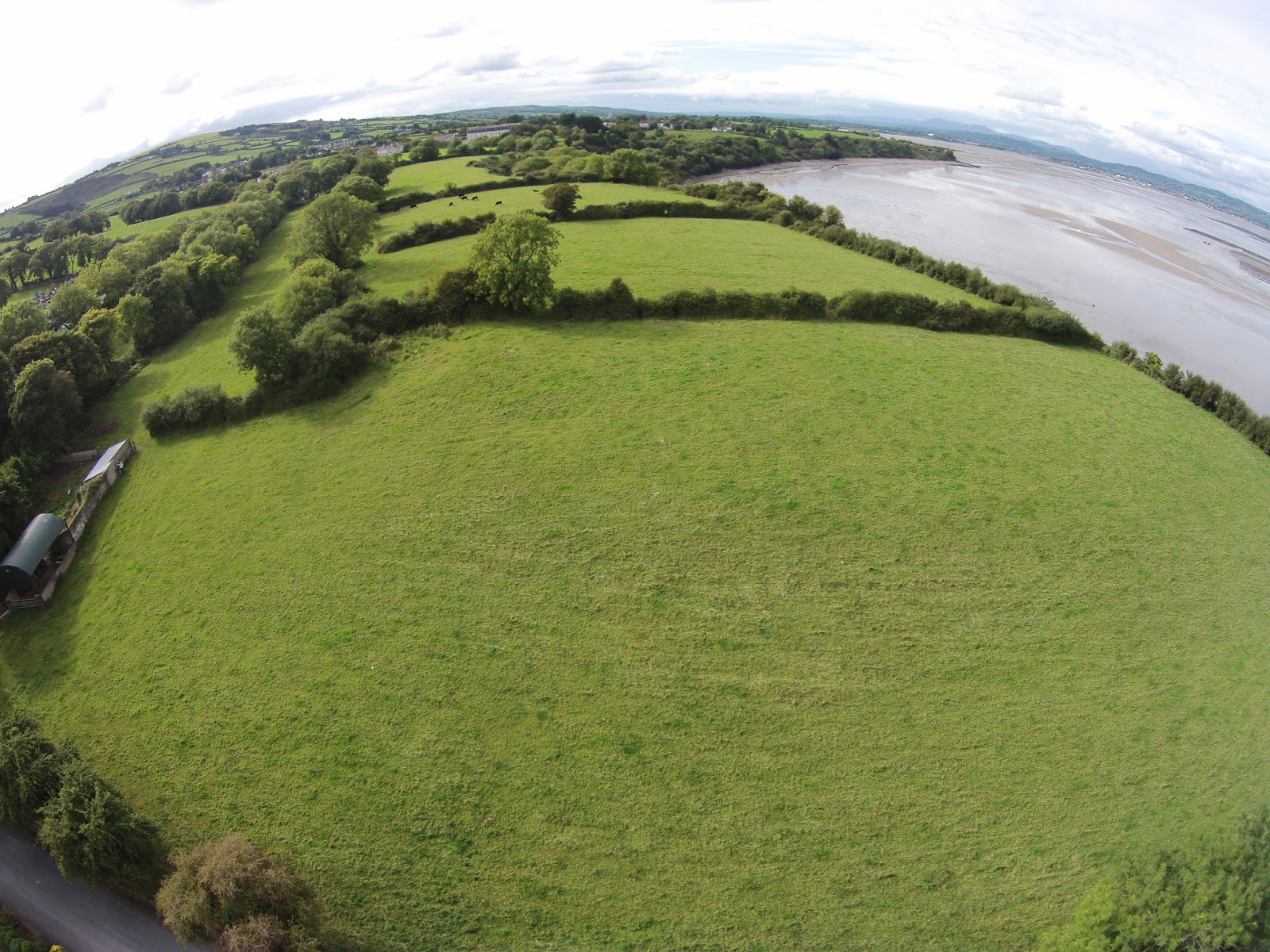
These wonderful images were taken by Patt Kenealy(c)
of the Ring Moat. Our investigation is ongoing as to origin.....
Sunday, February 22, 2015
The Wake
By Michael E Murphy
"Mr. Murphy is a retired lawyer who lives in St. Paul, Minnesota. His family has traced its Irish origins to Clashmore in western Co Waterford, where they held a clan reunion last September."
He'd said he'd send for her and their child within
and
the wake began -- as they always did -- with the giddy
gossoons clowning ahead of their elders along
the
mud-rutted boreen that wound down from Clashmore
to
the River Blackwater. The scent of salmon and seaweed
now
on the evening air replaced the smell of dung
and
potatoes rotting in the village fields above.
He'd said he'd send for her and their child within
when
his parents, Mike and Meg, his Mary and the others
carried their fare and firewood down to the landing
the
women with baskets of bread and turnips, the men
with wheelbarrows of wood and crocks of ale.
Freddy Malins, screwed on his own poitin, was seen
taking Colleen Boyle behind the boathouse.
He'd said he'd send for her and their child within
when night set in and the villagers raised their jars to him
and sang round the fire those melancholy, coffin-ship
send-for-me songs, and cried from too much grief or drink.
By dawn the villagers had gone. His parents and his Mary
would take him -- him with his ruck sack and tool belt --
over the river, then down to Cobh to board his ship
![]() |
| River Blackwater |
![]() |
| A stone mason at work; The craft of M E Murphy's ancestors at Clashmore prior to emigrating |
Monday, November 3, 2014
I spent a wonderful evening in the Company of Nioclás Ó Gríofán
and his nephew, Nioclás Ó Condon, sometime back in conversation with him about the history of his
particular area - Seaview - he spoke about the townland of Rathnameenagh. And I
was immediately curious to learn more about such a little area that held so
much history. And so, it came to pass that we met up on one sunny afternoon and
explored this hidden little treasure and in a subsequent interview with the man
in question, as ever his legendary Knowledge of local history was most revealing and rewarding. His use of the local dialogue is colourful and true. I have tried to
print it exactly as spoken because of the simple attractiveness of expression
which is sadly no longer in vogue among
the younger generation. Hopefully, I have done justice to the spellings of his
Irish placenames and in the event that I have not, readers’ comments will be
gratefully accepted. I have also taken the liberty of seeking Cannon Power’s
placenames for clarification, keeping in mind that the Good cleric was not always correct.I also consulted Dinnen's, 1927 Irish/English dictonary . Also, where possible I have sourced some photos / items of interest
mentioned by Nioclás to complements the piece. I have also taken some Poetic licence with my photos!
We are now in the townland of Rathnameenagh, Eddie it is a
big enough townland and up until 1847 it had 643 Acers in it. The Parish of
Ring was a parish on its own at the time, half of the parish of Ring was split
especially the upper part of it, and half of the townland of Rathnameenagh was
in Ardmore, so 259 acres of Rathnameenagh was in the Parish of Ardmore, Above the
road which they call the mountain and below the road then there was it 364 acres.
Eddie; The view that we now see before us is quite spectacular
We are re looking down on Muggort’s bay, Gleann Maguirt there is a massive hole out there, and they call it An Poll Mór, Muggort’s bay… You could say it runs from the point of Helvick to Ballycreen River. That’s all Muggort’s bay, that section out there!
Gleann Naugairt it’s called Eddie, It got its
name from a plant and as far as I know it’s the only bay in Ireland called
after a plant. Its Mugwort or great Figwort
Eddie; have you an interesting story connected with the bay?
It was around 1603, there was a Dutch man o war came in
there… she was lost with a cargo of cannons!
It was the first time
that locals saw a black man and him diving! He came and stayed at Helvick for a
year. He came hither from England and he dived, ‘twas the first time that diving
was seen and he only discovered four cannons.
I suppose that the rest of them
must be still down there, that was 1602/03 Owen McGary, I think is doing
something on her at the moment, trying to locate her..
It’s interesting the fact that the man came to dive, I don’t
know in them days how he was able to dive but they kept him there for 12 months
anyway. I think that they used to dive in them days with a kinda bucket on their
heads, anyway, the British, - go right or go wrong - wanted to get him for themselves to England but he
wouldn’t go back, so he never went to England. And he stayed in Helvick while he was doing
the job; whatever Dutch Company he was belong to!
Eddie; what was a Dutch man-o-war doing down there
Where the Man – O - war was heading for…I dunno…, that’s all, you know…she was known as the Phantom Ship, the older people used to be always saying, that at certain times of the year, they could see her… maybe when there was a gale coming, or something…she was out there in the middle of the bay!
Historically, and in a lot of ways, Muggort’s bay was a
great fishing ground out there for any kind of fish and anything like that, there’s
plenty of that out there, you know!
And there’s a lot of Gaibhlíns
out there Eddie and I’ll give them to you now. An Gleann is one of them, that’s where the deep water is…that is
where the big hole is, straight out there. The fishermen are always afraid of
it because it’s bottomless! And, then you have Carraig Breáig, that’s another rock that’s out there, it’s called
the stinking rock in English. Then there’s Carraig
na Croise, rock of the cross.
Carraig Bhréan – “Stinking Rock.”
Carraig na Croise– “Rock of the Cross.”
Eddie; Nioclás, are these all visible now to the naked eye?
The
only one you can see is Carriág Breán,
you see there a lot of them under water Eddie and a Gaibhlin means a wet place where they would be coming in between
the rocks…that’s what it is then!
Eddie, what exactly is the interpretation of Carriag na Croise… was
there a cross on the rocks?
No! I suppose the
fact that it was dangerous Eddie, well you also have Faill na Croise, Cliff of the cross…there… Now Gaibhlin na Churraigh, that’s a wet place, a sea inlet you know and
you also have Gaiblin na mbó which is
a little sea inlet for the cows. And there is also Tráig na mbó , an inlet also associated with cows.
Faill na Croise – “Cliff of the Cross.”
Gaibhlín an Churraigh - “Little Sea Inlet of the Wet Place.”
(f) Gaibhlín na mBó - “Little Sea Inlet of the Cows”; also Tráig na
mBó.
There’s three big rock formations there, there’s the Groig…the village, there’s the great the
middle and the small.
Gróig - “Village”; the name is applied to three rocks distinguished as
Groig Mhór, Groig Bheag and Groig Láir
(Great, Small and Middle) respectively.
Now, there’s the Cuil
Traga straid that’s the nicest one of them all, way out there Eddie.
This is where you get the spring water, under the cliff, the
one I was telling you about... It’s under the cliff which is about 300 feet
high. It was man-made years ago when they used to be fishing down there and the
tide comes in on it., you wouldn’t know the background of it, you’d think it’s
a holy water font…its built like a holy water font! And there’s three steps leading
up to it.
You can imagine the cold water that’s in that.
Eddie; So then why was it created, and especially down here in such a
secluded spot?
The reason why ‘twas done the fishermen long ago went out in
small boats, and they’d come in there and they’d get the spring water to make
the tea on the rocks there. They would gather brushnin along the strand, auld kipping’s
and things to make the fire and they’d make the tea. They wouldn’t have much in
them days anyway; they’d boil the fish down there. They had a great way for
boiling new potatoes, they’d have a saucepan with them and they’d boil them in
salt water and they’d put the fish on top of the pot while they were boiling
and they used to say that there was nothing nicer you ever eat, Eddie!
There’s Trá na Mbirineac, there are two meanings
for it!There was also a Lios, but that was never found…there are two meanings for Trá na Mbirineac and Mbirineac is black clay, that covers the road above the mountain and that which used to grow in the Cúil Trá,
I think I showed you a bit of it the other day!they used to make chairs and do thatching and things like that with it. That was Mbirineac long ago ‘twas very valuable because they needed it for a certain amount of things…I don’t know what the story is with that but they used to gather that long ago and there’s a river over under the quarry at Seaview and its call Tobar na inse the inch river and they used to bring it over there and wash it and they would use it after that for thatching and maybe some kind of pots for fishing. That can grow up to six feet Eddie, but only grow on the edge … look, you can see it…it won’t grow on the land… that is actually growing on
the stones!
You can see now that is right soft now you know and the idea when they wash it
they took the fluff off the top of it and hung it up to dry. But they used also
make súgáns out of it and used it for
chairs…there are strong roots in that, it is only growing fresh now it is very strong down the bottom, it’ll get
a lot bigger than that you see.
Cúil Trá - “Strand Nook.”
Súgáns;hay or straw rope, such as used for binding haycocks, as a belt etc, (Dinneen 1927)
Just around that rock there now
Eddie, that’s where the Peri was lost on November 2, 1907.
| Wreck of the Peri around to the right! |
And the Bang is around there, a
great place to fish for Pollack…there was also a Galleon went in there as well. Faill na Muc was where the Peri was lost
Pat O Dwyer was on her. There were only
two survivors …Pat O Dwyer, and Young was on her. I think…y’know. I remember
Pat O Dwyer, I was at his funeral …he was old IRA …he is buried here in
Dungarvan. It was the only funeral that I was at where three volleys was fired
over his grave!
Eddie; James
Young lost his life on board the Peri
The Cullinane’s lived in Knockpower, just at the boundary of the headland, they had 70 acres of land there, and sure they were evicted in the late 1880s. It wasn’t Henry A that evicted them…it was a different family evicted them… They had two acres above near the road and two acres on top of the cliff. And the top of the Cliff was the place that they always tilled.
Eddie; Who was the actual Landlord here back then Nioclás?
Rathnameenagh had its own landlord, Henry Fitzgerald he was known as Blind Henry A. The whole for Helvick Head to
Drommana…Lord Stuart de Decies was the Landlord . He had about 28.000 acres,
but he such a thing then as was called sub landlords. When Henry A, used get
the money from the rent for Seaview…when
I was a young fellow at home long ago I remember going down to Sullivan’s who was there then…you paid the rent of the first
of November every year, the rent was one pound and three shillings for four acres of land. I remember as a young fellow going
down there with my father, he used to bring the seaweed up from the strand on
the donkey’s back and make ridges there.
Eddie; he used to bring it up
that steep incline that was some job? It
was certainly a long aul pull!
Just from down there Eddie; twas, twas hard enough to go down to it, I’d say it was this side of it isn’t that a fright, you were near the strand , they were on top of the cliff and there was good paths there , there was four families that used to till down there, there was the Morrissey’s, the Humphries and Mike Roche , so they had the same amount of land, maybe two acres each and tis down there then that they had all their vegetables then , the vegetables then was only cabbage …that’s all I ever saw there then was cabbage and potatoes. There used to be lovely potatoes down there …you needn’t have to wash them because they were sandy, as a matter of fact, one of the men there, Mike Roche … you see the potatoes could be set down there in February Eddie, because the frost would never bother them, they were protected from the North wind and they could set them there early, but Mike Roche used to have two crops of potatoes every year. When he’d dig the first of the potatoes maybe the first of July he’d be finished with them. He’d set other potatoes then, and he’d dig them in October and he’d sell them as seed potatoes.
Eddie; tell me about Henry A?
Henry A was a Justice of the peace
you see.
Any landlord had a that title you see Rathnameenagh was the townland, that was Seaview House you see, there was no place named Seaview , just that he called it Seaview House, because he had a view of the sea you see. I saw one time, that if you wanted to go into the British Army or the navy or an RIC man in particular, you’d have to get a letter from him! And what he wrote in the letter for one local man when he gave him the recommendation…he said that was a devote Catholic but a staunch Unionist! That’s what he recommended him on! Because a Catholic in them days would not have a hope of getting into the R.I.C , you had to be a kind of a staunch Unionist to get in there! That’s what he done, you see if there was a court then…we’ll say in Dungarvan or anyplace, you see all the Justices of the peace… Gortadiha house, Seaview and Ballymacart or something like that, they’d all be inside in Dungarvan, there’d be three Justices. And one fellow went in, of course you had no hope. You see when you went in front of them because they wouldn’t even listen to you …they kind of said that this fellow is only a bit of a fooleen , they wouldn’t even listen to you, you got no Justice at all!![]() |
| Dungarvan Court House |
It was Henry A Fitzgerald in 1867
that tried the Fenians in Dungarvan, twas he sent them to a court in Waterford,
and then they were sent to Sligo for their final trial. One of the Fenians said to him…of course
there was one of the Fenians that was local, he was Whelan from Ballinagoul,
the rest of them were from around Ballymacoda &Youghal, they kinda knew
the area it seems…they came in, 32 of them as you know…they fought in the
American Civil war but when they came in here. The rising of 67 was over and
tis by mistake that they came into Helvick. But when Henry A questioned one of
them inside in town …’what kind of fellows was in the Fenians y’know…This
fellow said, ‘One of them is like yourself sir!’ He was clever enough! They spoke only all in Irish,
Pat Mor Ó Faoláin they came in there to Poll na Phuca there under the College, the Monument is
in Helvick as you know! Twas only put in Helvick. The Captain of the boat was
Captain Kavanagh, he was from Passage East and where they held a meeting for
the Fenians before they came here was in a house by the name of John Bastion
and he was the granduncle of the great Waterford hurler Ned Bastion who won an all-Ireland
in 48.
GORTADIHA, Gort na Daibhche –
“Garden of the Cauldron (or Hogshead)”; so named, no doubt, from tub-like dips
or hollows in the surface.
BALLYNAGOUL, Baile na nGall -
“Homestead of the Foreigners.” A local tradition, which seems to be English in
origin (and therefore unreliable), states that the foreigners were the crew of
a Turkish vessel (Algerine Rover) wrecked here.
Its overgrown now where the gardens
were, there were two brothers of the Morrissey’s there Eddie, Nicholas
Morrissey William Morrissey, I’m going back now to the 1880s and they hadn’t to
get no assistance from the Quakers when they came to Ring in the 1847-48s,
because I think, some parts along by the coast , the blight didn’t hit it. And
this was one of the places. Anyway, they had a system going…those fellows the
Morrissey’s and Seáneen de Breathnach
he came in from the Schkeens, and married one of the Morrissey’s. They had a
system going themselves anyway, they cured all the fish that they caught during
the summer and they used to go up…they were kinda caught because when it was
time to be making the ridges for the potatoes up in Colligan, they’d take a contract
up there and then they’d set the potatoes there and they’d put the clay with
them and they’d dig them again at the end of the year when it was all over. But
I used often hear my father Lord rest
him saying; whatever happened , they’d be home …they’d do a half day on
Saturday, so that they would be home for mass on Sunday! And then they’d walk
it up again to Colligan on Monday
morning and stay up there for six days
before they’d come back again.
Eddie; Where did they sleep when they were in
Colligan was it lofts of farmers houses?
In farmer’s houses, I suppose.
You see they were selling fish as well They built their own boats actually , they all built their own boats…actually some of them got on
very well, some of them now , they went to America Eddie, There was senator
Morrissey in Boston . Morrissey Boulevard in Rochester called after … Remember you
wrote about them for the Newspaper Eddie, They were all born down there Eddie.
That’s where their grandparents came from and that’s how they lived you see.
They lived off the sea with the Fish and they lived off the land with the
potatoes. And, as well as that then, Reverend James Alcock , who was on the
relief committee of Ring.
| Memorial erected to the Quakers |
They got such great assistance from the Quakers…they brought the Quaker money to Ring during the famine , well he stayed at Seaview house , there was an extension built on to that. Fitzgerald was a Catholic , and while Alcock was in ring he stayed in Seaview house the extension was there, I remember as a young fellow , the ruins of the old house are still there , Henry A Fitzgerald, he must have been good at music because there was a big piano there which he must have been playing it! But, he was very fond of the Irish language because (Eddie maybe his wife was playing it) no he never married he was on his own, but he done wonderful work for Ring during the famine, especially Ballinagoul, he organised all the nets, and the Indian meal and all that. He was a brilliant writer, hiswritings were something else! He
had to give an account for every penny that he spent. He was one of the most
interesting men that came to Seaview, he lived there until he died in 1893, he
is buried in the Church of Ireland,
Eddie; where was the house?
It later became Sullivan of
Seaview, the old house is gone, twas neglected, there was a new house built
there. Twas never a big house, twas just a long house …Willie Fraher drew a
drawing of it one time. You have Ballinacourty over there,
down there now was only a small little house where my father was born, Fr Warner took a photo of it in 1940s , tis hanging up over in the college and there was an aul garage there for Stuart
for the car!
Subscribe to:
Posts (Atom)
Anna Haslam and the Quakers of Piltown and Youghal
My god friend Mike Hackett who resides this side of Youghal Bridge is Youghl's foremost Historian. Mike has several books behind him And...
-
Saving the Oceans, one man’s commitment. ‘I want to give something back.’ By Eddie Cantwell This is the e...
-
Youghal Historian Mike Hackett Sailors and Seamen of Youghal who lost their lives to the water. My thanks to Mike Hackett , Yough...
-
Joshua William Strangman. A Quaker of Waterford and his connection with Ring fishermen. By Joan Johnson ...


.jpg)